dryoasisplants
Aloe ×heteracantha Baker
Aloe ×heteracantha Baker
This plant listing for reference only.
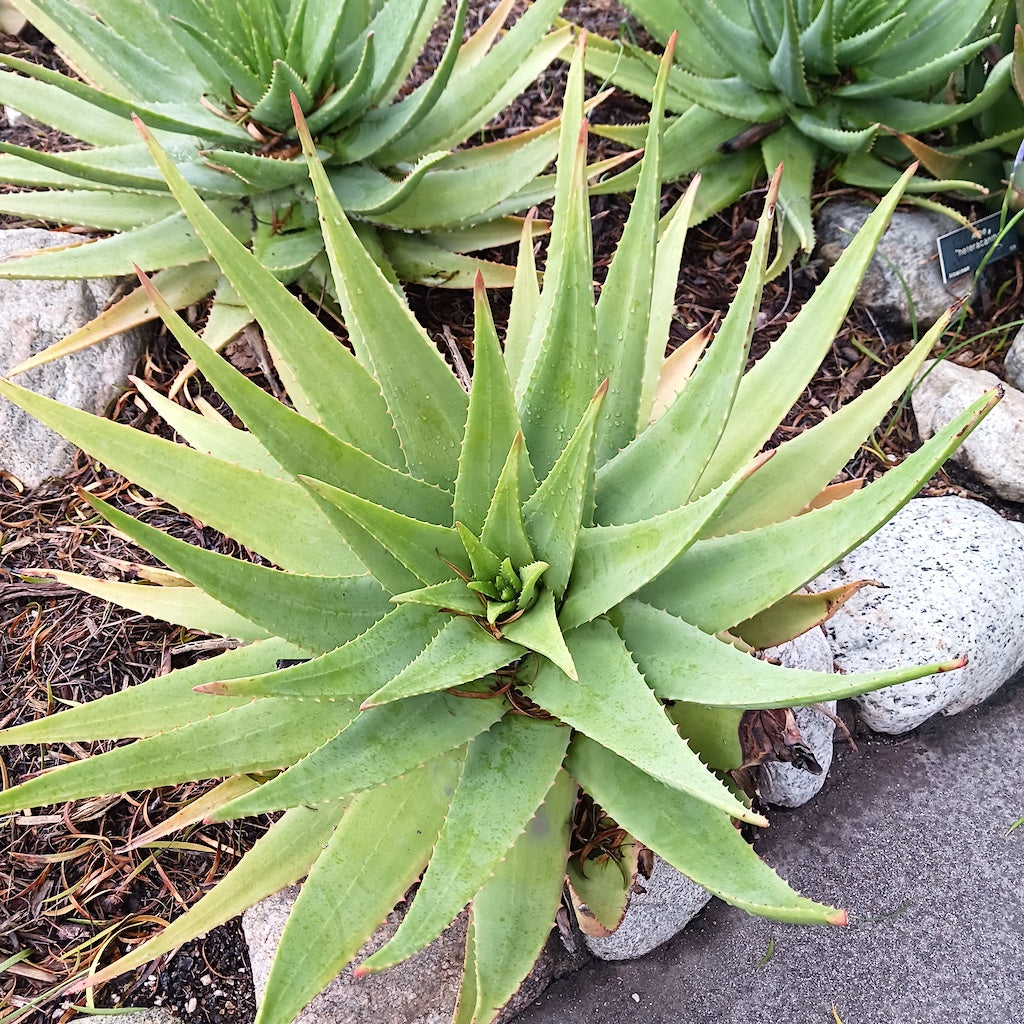
Aloe heteracantha Baker is a stemless or very short-stemmed aloe forming a broad, dense rosette of numerous fleshy, lanceolate leaves. The leaves arise tightly from the center, with the younger inner leaves held erect to ascending and the older outer leaves spreading broadly before arching or recurving toward their tips. Mature foliage is generally green, becoming somewhat paler or more yellow-green toward the older outer leaves. The leaves taper gradually from a broad base to a sharply pointed apex and are shallowly channelled toward the upper surface of the base. Marginal armature is relatively sparse and variable: some portions of the margin may be nearly entire, while others carry a few small, widely spaced, triangular teeth. The teeth are often pale when young and may develop reddish-brown tips. Baker's original description gives a rosette approximately 15–18 inches across, with leaves 9–12 inches long and 1⅓–2 inches wide, although mature cultivated plants may become considerably larger. The overall habit is distinctive for its combination of long, relatively narrow leaves, a broad spreading rosette, and comparatively restrained marginal teeth.
The name Aloe heteracantha was published by the English botanist John Gilbert Baker in 1880 in the Journal of the Linnean Society, Botany. Baker described a plant with a short, simple stem and a dense rosette 15–18 inches in diameter. He noted that the leaves were green, lanceolate and acuminate, approximately 9–12 inches long, shallowly channelled above the base, and occasionally marked with irregular white spots. The margins were described as sometimes entirely without teeth, but more commonly bearing a few small, unequal, deltoid teeth. At the time Baker published the species, its flowers were unknown and its native country was recorded simply as unknown. The plant was already being cultivated at Kew, which means that A. heteracantha entered botanical literature as a cultivated plant whose original provenance was uncertain.
The plant was subsequently illustrated and described in greater detail in Curtis's Botanical Magazine in 1886, as plate 6863. The Kew account noted that the plant had been grown there for a considerable period but had not previously flowered, and that its history was unclear. It was believed to have been brought to Kew from the Jardin des Plantes in Paris many years earlier. The flowering plant was described as having a stout, two-edged flowering stalk and a branched, racemose inflorescence composed of dense cylindrical racemes. The flowers were described as bright red, with a short perianth tube and stamens approximately equal in length to the perianth. This publication is important because it supplied the first published description of the flowers of Aloe heteracantha, completing the botanical description begun by Baker six years earlier.
The taxonomic history becomes more interesting as later botanists came to regard Aloe heteracantha not as a distinct wild species but as a hybrid. Modern treatments generally use the name Aloe ×heteracantha Baker and interpret the plant as the hybrid between Aloe arborescens Mill. and Aloe maculata All. A modern review of named Aloe hybrids lists Aloe ×heteracantha Baker as dating from Baker's original 1880 publication and gives A. arborescens × A. maculata as its parentage. The same treatment associates Aloe ×inermis Baker, also published by Baker on the same page in 1880, with the same hybrid combination and considers it a synonym of A. heteracantha.
This interpretation is also reflected in more recent nomenclatural literature. A CITES taxonomic reference lists Aloe ×heteracantha Baker as an artificial hybrid of Aloe arborescens and Aloe maculata. The hybrid interpretation helps explain the plant's intermediate appearance: A. arborescens contributes the long, narrow green leaves and broad rosette habit, while A. maculata is among the ancestors associated with the more variable spotting and comparatively modest marginal armature. The photographs of cultivated plants at The Huntington Botanical Gardens show a plant that fits well within this historical horticultural concept, although morphology alone cannot establish the parentage of an individual specimen.
There is therefore an important distinction between the historical and modern uses of the name. Aloe heteracantha Baker is the name under which the plant was formally described in 1880 and subsequently illustrated at Kew, while Aloe ×heteracantha is the name used when it is treated according to its presumed hybrid origin. The original description is nevertheless valuable because it documents a recognizable horticultural plant more than 140 years ago, when its provenance and true status were already uncertain. The persistence of the name in botanical gardens and horticultural collections illustrates the difficulty of separating naturally occurring species from cultivated hybrids in a genus with a long history of hybridization and exchange among European botanical gardens.
For that reason, Aloe heteracantha is best understood today as a historically established horticultural name associated with Aloe ×heteracantha, rather than as an unambiguously distinct wild species. Its botanical history begins with Baker's 1880 description of a plant of unknown origin, continues with its first recorded flowering and illustration at Kew in 1886, and culminates in the later recognition of the plant as a hybrid of Aloe arborescens and Aloe maculata. The name remains useful when discussing the historical plant and its horticultural identity, while the multiplication sign in Aloe ×heteracantha conveys its modern taxonomic interpretation.
Historical sources
- Baker, J. G. 1880. “Aloineae and Yuccoideae.” Journal of the Linnean Society, Botany 18: 161. This is the original publication of Aloe heteracantha and contains Baker's measurements and description of the vegetative plant.
- Curtis's Botanical Magazine, 1886, vol. 112, plate 6863. This is the first published account of the flowers and includes the botanical illustration of Aloe heteracantha.
- Glen, H. F. & Hardy, D. S. 2000, as cited in later Aloe taxonomic literature. The modern hybrid interpretation identifies Aloe ×heteracantha as Aloe arborescens × A. maculata.
- CITES. Current Aloe nomenclatural reference. Lists Aloe ×heteracantha Baker as an artificial hybrid of Aloe arborescens × A. maculata.
USDA Zones:
Frost Tenderness:
Shipping & Returns
Shipping & Returns
We ship US domestic orders within 5-10 business days! Read more about our shipping policy
Photo Use Notice: Most images on this page are original and protected by copyright. You may use them for educational or non-commercial purposes with a clear credit link to Dry Oasis Plants.
View full details