dryoasisplants
Aloe "Mango Madness"
Aloe "Mango Madness"
This plant listing for reference only.
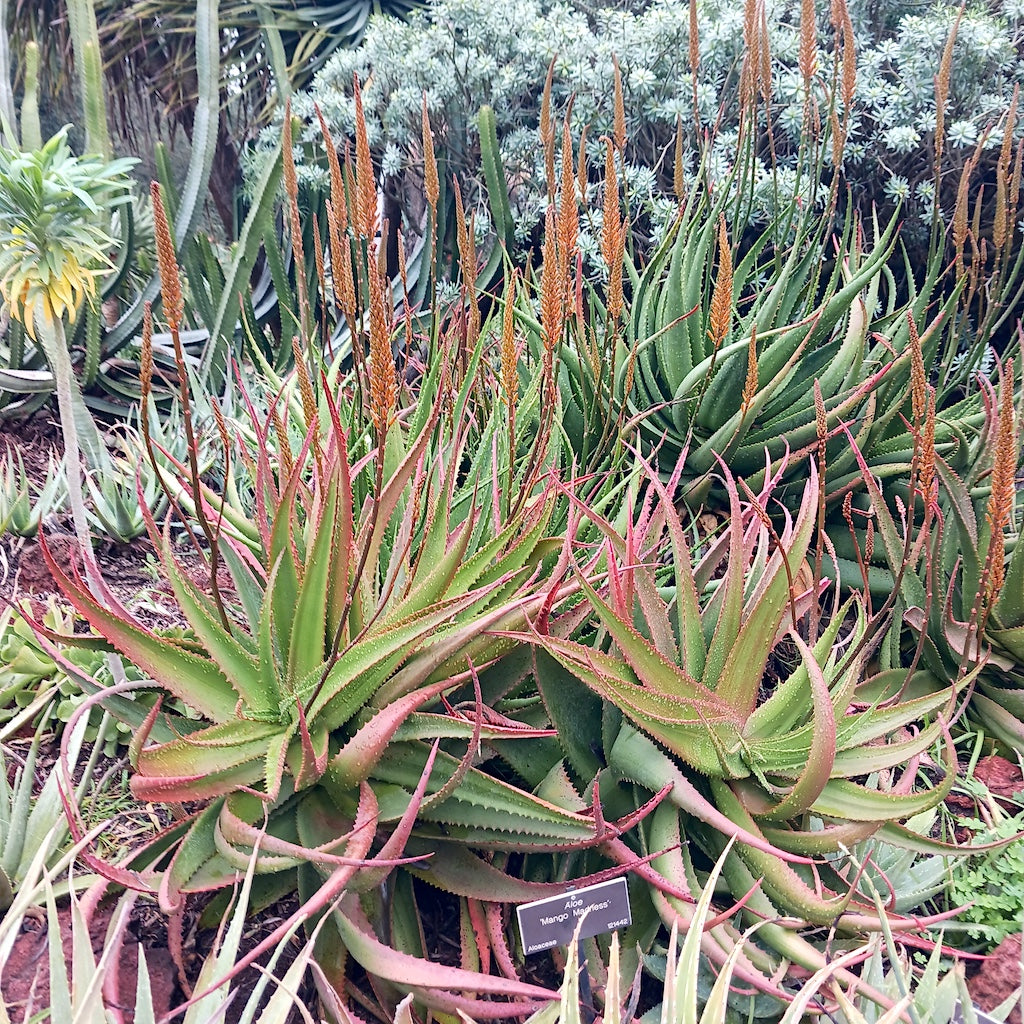
Aloe 'Mango Madness' is a distinctive Aloe hybrid valued for its strong, spreading rosettes, seasonal foliage coloration, and large clusters of warm mango-colored flowers. It was created by Brent Wigand in California from a cross between Aloe vanbalenii and Aloe cameronii. The combination brings together characteristics of both parent species, including the broad form and coloration associated with A. vanbalenii and the strong flowering and reddish foliage associated with A. cameronii.
The plant forms substantial rosettes that can eventually produce clumps. The leaves are long and lance-shaped, with a channelled upper surface and sharp, reddish marginal teeth. Foliage is generally green but can develop coppery or reddish tones under strong sun and during periods of seasonal dryness. Mature plants can reach approximately 3 feet in diameter, making 'Mango Madness' a substantial Aloe rather than a small container specimen.
The flowers are the feature that gives 'Mango Madness' much of its appeal. Tall flowering stems rise well above the foliage and carry dense, somewhat narrowly conical racemes of orange to mango-colored flowers. The flowering display is particularly effective against foliage that has developed reddish or coppery tones. Plants can flower during winter and may produce additional flowers at other times under favorable growing conditions.
'Mango Madness' is suited to USDA Zones 9–11 and should be protected from prolonged or severe freezing temperatures. Like its parent species, it performs best in full sun to light shade and in sharply drained soil. Watering should be moderate, with the soil allowed to dry between waterings. Its substantial eventual size makes it better suited to the landscape than to long-term container culture.
In the garden, 'Mango Madness' works well as an architectural specimen, in succulent and dry gardens, or as a large container plant while young. Its combination of substantial foliage, seasonal reddish coloration, and tall orange flowers gives it interest throughout much of the year.
The cultivar also has a connection to the long history of Aloe cultivation at the Huntington Botanical Gardens, where it remains represented in the living collection. The Huntington plant photographed for this reference is recorded under accession number 121442.
USDA Zones:
Frost Tenderness:
Shipping & Returns
Shipping & Returns
We ship US domestic orders within 5-10 business days! Read more about our shipping policy
Photo Use Notice: Most images on this page are original and protected by copyright. You may use them for educational or non-commercial purposes with a clear credit link to Dry Oasis Plants.
View full details