dryoasisplants
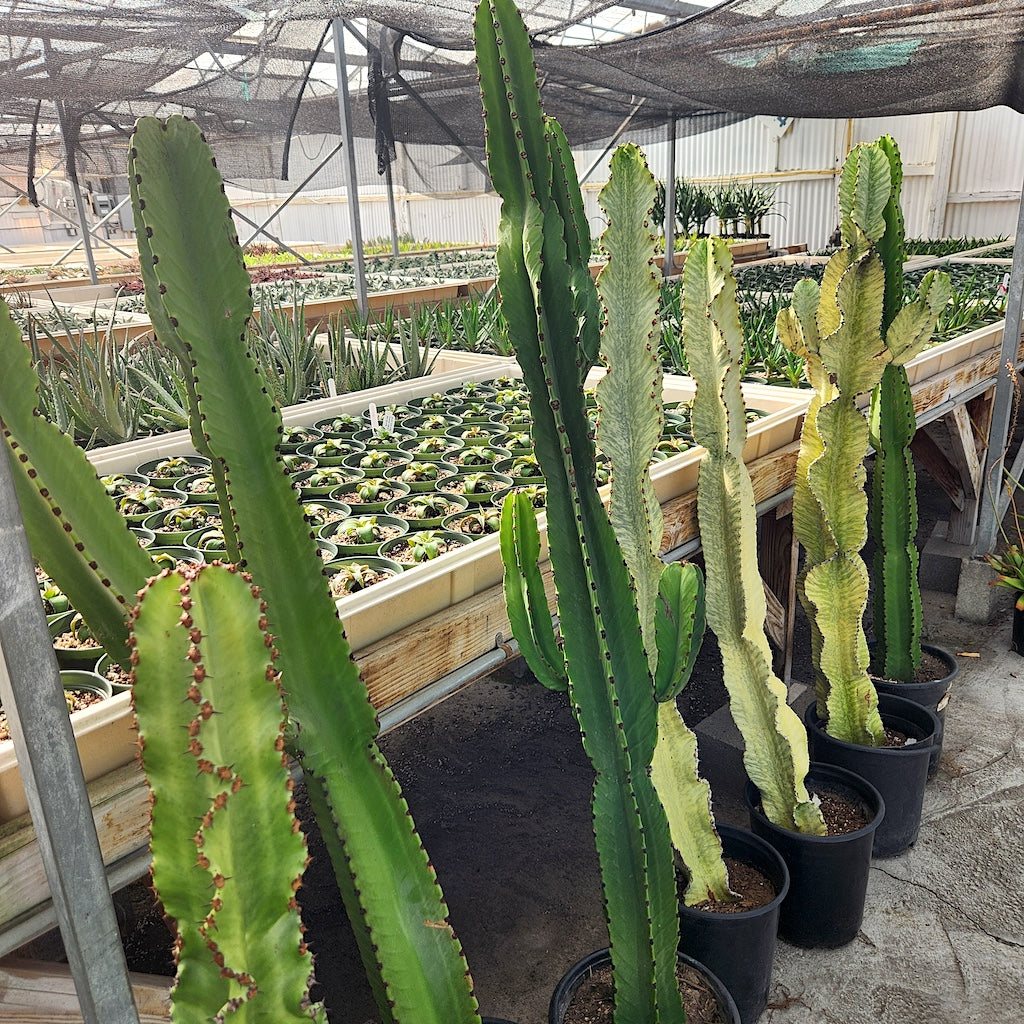
Euphorbia ingens - 4'-5' branched
Euphorbia ingens - 4'-5' branched
Shipping calculated at checkout
Cold Climates - Add Heat Pack
Cold Climates - Add Heat Pack
For cold climates with upcoming sub-32-degree temperatures within five days of your order, we strongly advise adding a heat pack. Orders without a heat pack will not include one.
To prevent plants from freezing while in transit, orders placed for areas with severe freezing temperatures will be held for shipment until it is safe to ship.
Couldn't load pickup availability
Pickup only - No Shipping.
Euphorbia ingens is a large, tree-forming succulent native to eastern and southern Africa. It develops a stout trunk that branches and rebranches to form a broad, rounded crown of upright or ascending green branches. Mature plants can reach about 10–12 m tall in favorable conditions, although cultivated specimens are generally much smaller. The four-angled branches are divided into short, irregularly constricted segments, with small, widely separated spine shields along the ridges. The spines are greatly reduced, giving this species a less heavily armed appearance than many other tree Euphorbias. Small yellow to yellow-green cyathia appear near the ends of the branches from autumn into winter, followed by rounded three-lobed fruits that turn reddish to purple as they mature. Grow Euphorbia ingens in full sun or very bright light and sharply drained soil. Allow the soil to dry between thorough waterings and keep plants much drier during cool winter conditions. It is highly drought tolerant but frost tender and is best suited to frost-free climates. Its substantial size makes it most appropriate for spacious dry landscapes, succulent gardens and large containers. The milky latex is highly irritating and can cause serious eye injury, so use gloves and eye protection when handling or pruning.
Euphorbia ingens is sometimes confused with the similar Euphorbia ammak. For the average gardener, mature plants can usually be distinguished by their form: E. ingens tends to develop a dense, rounded crown with many upright, closely spaced branches, while E. ammak generally has fewer, thicker branches that give it a more open, candelabra-like appearance. E. ingens also tends to retain lower branches as it matures, contributing to its broad crown. Young plants can be much harder to distinguish, so the overall form is best used as a guide rather than a definitive identification.
Current Height: 5 ft
Container Size: 5ga
USDA Zones: 9b - 11
Frost Tenderness: 25 °F
Shipping & Returns
Shipping & Returns
We ship US domestic orders within 5-10 business days! Read more about our shipping policy
Photo Use Notice: Most images on this page are original and protected by copyright. You may use them for educational or non-commercial purposes with a clear credit link to Dry Oasis Plants.
View full details